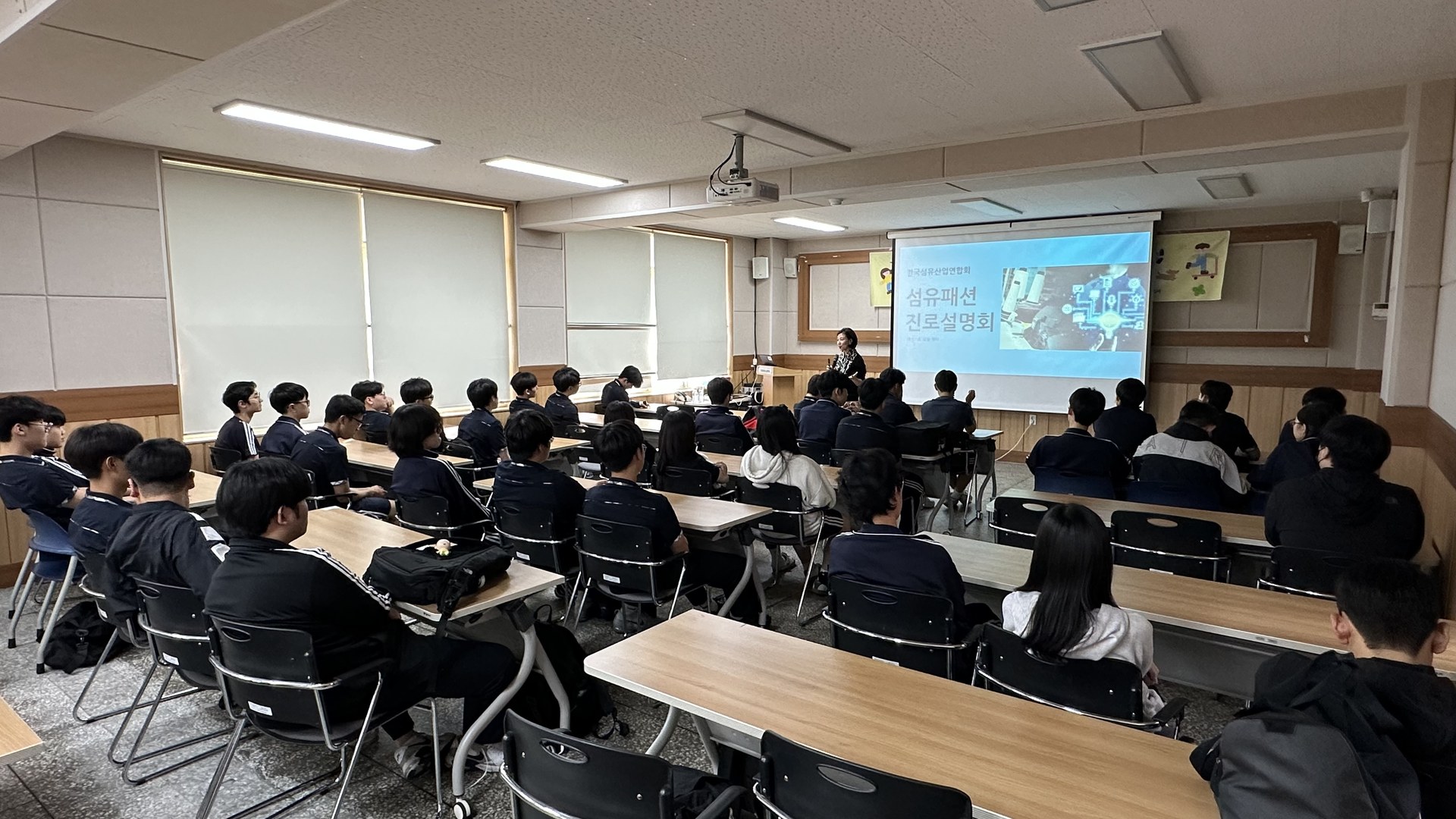
Companies can't find the people they need, and students hesitate because they don't know what kind of work to pursue. The textile and fashion industry's workforce problem ultimately comes down to one question: where should this gap start to be closed? Is it enough to introduce young people to the industry only after they've entered the job market? The Korea Federation of Textile Industries (KOFOTI; Chairman Choi Byung-oh) is continuing its effort to move that point of contact forward, into vocational high school classrooms.
From Wednesday, August 12, to Tuesday, September 22, KOFOTI held its 'On-Site Career Briefings for Textile and Fashion Vocational High Schools' at 13 vocational high schools across the country. Participating schools were Seoul Technical High School, Chuncheon Hansaem High School, Incheon Mirae Saenghwal High School, Gunja Digital Science High School, Anyang Technical High School, Yerim Design High School, Seongdong Global Business High School, Ahyeon Industrial Information School, Daegu Technical High School, Gyeongbuk Technical High School, Yeungnam Technical High School, Gyeonggi Business High School and Gyeongnam Technical High School. A total of 568 students majoring in textiles and fashion took part.
The program is part of the 'Textile Industry Human Resources Development Council (SC) Support' initiative backed by the Ministry of Trade and Industry. KOFOTI said it designed the event to deepen vocational high school students' understanding of the textile and fashion industry in practice, and to support career choices tailored to each student's aptitudes and aspirations, with the goal of resolving the industry's workforce mismatch. A mismatch refers to the gap between the competencies companies need and the skills and preferences job seekers bring.
What changed this year is geographic scope. According to KOFOTI, the program expanded beyond its existing coverage of the Seoul metropolitan area, Chuncheon and Daegu to include the Busan region, offering career exploration opportunities to vocational high school students on a nationwide basis. Given that the talent pipeline does not originate in any single region, extending outreach to the regions is closer to a basic requirement of program design.
The content placed weight on real-world experience. Industry professionals from major Korean fashion companies such as E-Land and LF, along with lead instructors, took the stage as speakers. The lectures covered how the fashion industry is changing amid the AI transition and ESG management trends, as well as the competencies required for specific roles such as merchandisers, designers and marketers. Speakers also shared practical know-how, including how to write a cover letter in the generative AI era and a guide to launching a fashion business. The program was structured as a single arc linking the broader industry landscape, individual job roles and the concrete hurdle of application documents.
The format also went beyond one-way lectures. KOFOTI said it boosted participation and engagement by introducing 'interactive career counseling' built around students' real-world concerns, such as credentials, educational background, employment and entrepreneurship, along with a 'QR code-based real-time Q&A system' on site.
Results were presented in numbers. In a satisfaction survey with a 79.6% response rate, 80.0% of respondents said the briefing had helped them make actual career decisions. Particularly noteworthy are the students' areas of concern. When asked what they worry about most in preparing for employment, 56.2% cited 'concerns about aptitude' and 33.1% cited 'researching companies they want to join.' As for support needed going forward, application document writing and interview practice (37.7%) and one-on-one job mentoring tailored to desired career tracks (37.7%) were selected at the same rate.
Feedback also came from the schools. Oh Eun-hee, a department head at Seoul Technical High School, said, "The hands-on lectures by experts from well-known Korean companies were extremely beneficial, allowing students to explore a range of career paths and encounter vivid experiences from the industry," adding, "I hope this kind of support will continue in the future."
Read through the lens of program structure, the survey results make the task ahead clear. This is the reporter's interpretation. While students' concerns are concentrated at the 'direction-setting' stage of aptitude and company research, the support they are asking for spans the 'personalized' stage of application documents, interviews and one-on-one mentoring. If briefings for large groups served to help students find their direction, this can be seen as a signal that the next step must be support broken down to the individual level. That is because lecture-style programs can reach broadly, but they are limited in their ability to accompany individual students all the way through to a career decision.
KOFOTI has also built this direction into its plans. The federation said it intends to strengthen structured career programs for textile and fashion majors, including one-on-one job mentoring and portfolio and interview preparation, in order to cultivate the future talent the industry demands and provide employment support tailored to companies' needs. By way of commentary, the key will be how far KOFOTI can deepen the intensity of personalized support while sustaining its expanded regional reach and the scale of student participation. Whether its talent development efforts can shift from one-off events to a connected structure that runs through to career decisions and hiring appears to be the next decision KOFOTI must work out.